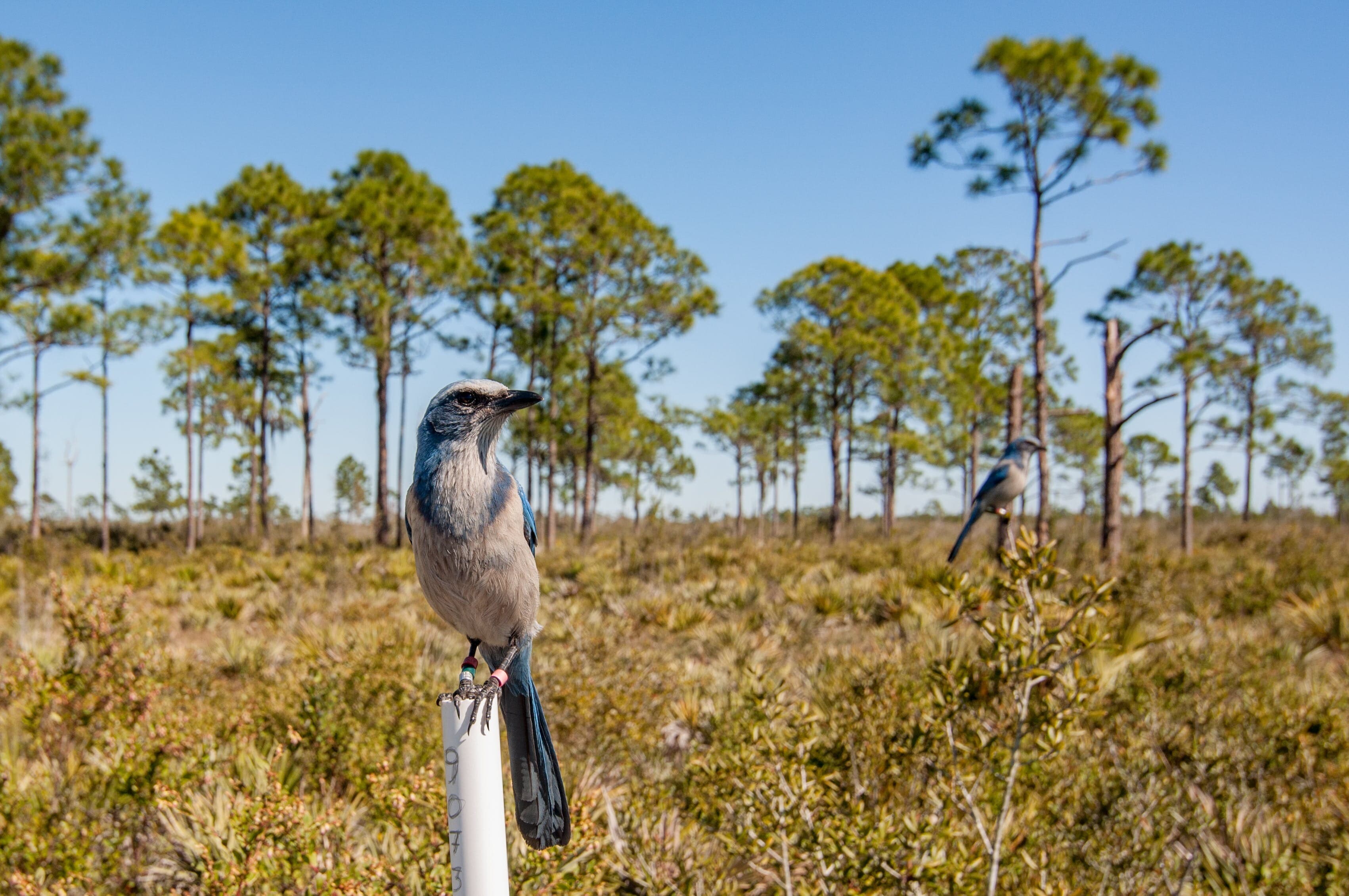
Conservation Partners and The Mosaic Company Deliver First-of-Its-Kind Win for Florida's Threatened Scrub-Jay
Early results suggest ambitious conservation effort is already helping birds establish territories, form pairs, and breed.
TAMPA, Fla. (July 28, 2026) — Conservation partners and The Mosaic Company have successfully relocated 48 federally threatened Florida Scrub-Jays to Wingate Creek State Park in Manatee County in an effort to strengthen a small, isolated population and improve the species' long-term prospects in the region. This first-of-its-kind effort brings together birds from three distinct populations across Florida to enhance genetic diversity and improve the species’ long-term viability in the region.
The project represents a significant collaboration among public and private partners, including The Mosaic Company, the U.S. Fish and Wildlife Service, Verdantas, the University of Central Florida, and Archbold Biological Station. Regional contributions from Manatee County, Southwest Florida Water Management District, Florida Department of Environmental Protection, Florida Fish and Wildlife Conservation Commission, and Regional Land Managers were also instrumental in preparing and maintaining suitable habitat conditions.
Found nowhere else on Earth, Florida Scrub-Jays depend entirely on Florida's shrinking scrub habitat. As development and habitat fragmentation continue to reduce and isolate suitable habitat, small populations face elevated risks of decline and local extinction.
The project brought together young Florida Scrub-Jays from three populations across the state, including Archbold Biological Station, Cape Canaveral Space Force Station, and Duette Preserve. By introducing birds from multiple populations, researchers hope to increase genetic diversity and reduce the risks associated with inbreeding in a population that has become increasingly isolated over time.
Researchers focused on relocating young birds entering their first breeding season, a strategy designed to give the birds the greatest opportunity to establish territories, choose mates, and successfully integrate into the new population.
The translocation builds on more than 25 years of habitat restoration and management in Manatee County, as well as decades of Florida Scrub-Jay research and monitoring across the species' range. The project was also informed by long-term research showing that conservation efforts must address both population size and genetic diversity to support long-term recovery.
Researchers say the project is already showing encouraging signs of success.
All 48 birds survived the initial translocation period, and ongoing monitoring continues to track survival, dispersal, and territory establishment among the relocated birds.
The birds have established territories throughout Wingate Creek State Park and formed 11 family groups, with several pairs already initiating nesting activity during their first breeding season.
Equally encouraging, several translocated birds have already dispersed into surrounding scrub habitats and interacted with nearby Florida Scrub-Jay populations. Researchers view these movements as an important early indicator that the project may immediately help new genetics to be integrated across the broader regional population.
The project was designed not only to increase the number of Florida Scrub-Jays in the region, but also to strengthen genetic diversity by introducing new genes from populations that have become increasingly isolated over time.
“At Mosaic, environmental stewardship means taking a long-term view of the landscapes we manage and the species that depend on them,” said Dr. Raoul Boughton. “The early success of this translocation reflects more than 25 years of studying and monitoring efforts to grow the regional Florida Scrub Jay population. Insights from translocations conducted between 2003 and 2010 helped us refine our approach, while genetic diversity studies showed there was even more we could do to support the species’ recovery.”
The project builds on decades of habitat restoration and land management by regional partners working to conserve and restore scrub habitat throughout southwest Florida.
Before the translocation, the regional population that includes Wingate Creek State Park supported 56 breeding pairs. Researchers estimate the project could ultimately add up to 12 new breeding pairs just in Wingate Creek State Park over the next three years. With early dispersal, it is likely that more pairs will form in the regional population, helping to accelerate recovery and improve the long-term resilience of Florida Scrub-Jays in southwest Florida. The goal is to reach more than 100 breeding pairs.
Scientists will continue monitoring survival, reproduction, dispersal, and genetic diversity in the coming years. Data collected through banding, monitoring, and genetic analyses will help inform future conservation strategies for Florida Scrub-Jays and other at-risk species.